


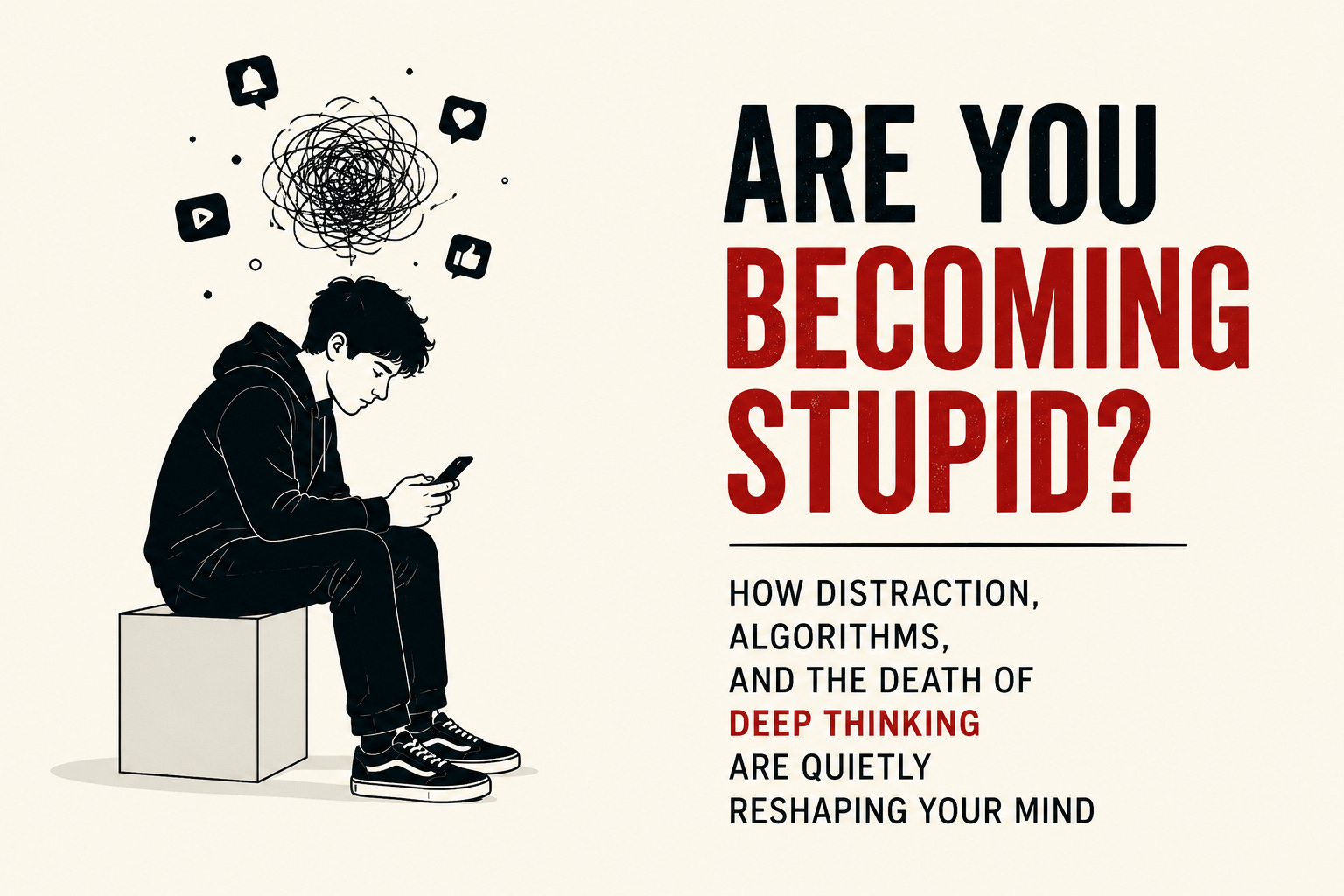
We have more information than any generation in history, yet less patience to think deeply about any of it.
The Quiet Unraveling of Society
Imagine waking up one day and realizing that the very fabric of society is quietly unraveling before your eyes.
Conversations seem shallower. Entertainment increasingly rewards noise over depth. People often know more about celebrities than about the forces shaping their own lives.
And despite living in an age of infinite information, true wisdom feels rarer than ever.
This raises a disturbing question:
Why does society seem to be becoming more intellectually shallow every day, and, most importantly, what can we do about it?
To understand this, we must first confront an uncomfortable truth. The very tools that promise to elevate human knowledge, technology, social media, and mass education, are often being used in ways that dull our minds instead of sharpening them.
Humanity has access to the greatest library ever created. We possess more information than all previous generations combined.
Yet attention spans are shrinking, critical thinking is increasingly threatened, and people struggle to distinguish between truth and falsehood. It is as though, in the rush to consume information, society has forgotten how to digest it.
If this reflection resonates with you, consider supporting Philosophy Vault. Your one-time support helps keep this work independent.
A cup of coffee for me is a cup of inspiration for you. Support my work through Buy Me a Coffee and help me keep exploring the depths of existence. ☕
The Triumph of Comfort Over Depth
Philosophers warned us about this danger long ago.
The German philosopher Friedrich Nietzsche spoke about the last man, a future individual who avoids depth, lives for comfort, and shuns anything that demands genuine thought.
Does that not sound familiar?
We live in a world where convenience often triumphs over wisdom.
Likewise, Neil Postman, in his seminal work Amusing Ourselves to Death, imagined a culture in which entertainment would become the lens through which reality itself is filtered—reducing even the most serious matters to spectacles designed to capture attention for a few fleeting seconds.
But why has this shift accelerated so dramatically?
One reason lies in the way human beings respond to stimulation.
The psychologist Daniel Kahneman, who studied the different processes involved in human thinking, demonstrated that we often prefer quick and effortless answers to slow, deliberate reasoning.
Modern society has learned how to exploit that weakness.
Social media platforms, advertising, and political discourse frequently prioritize emotional reactions over deep reflection.
In this environment, intellectual shallowness is not always accidental.
The systems surrounding us often reward it.
Think about viral trends, memes, and sound bites.
They spread not necessarily because they are true, but because they are simple, emotional, and easy to consume.
Compare this with the ancient traditions of philosophy.
In Plato’s Academy, students spent years wrestling with difficult questions, debating ideas, and refining their understanding.
Today’s public sphere often rewards those who shout the loudest rather than those who think the deepest.
This is the modern tragedy:
An abundance of information combined with a famine of wisdom.
When Information Replaces Understanding
The consequences are profound.
When people lose the ability to think deeply, they become more vulnerable to manipulation. False information can spread rapidly because it is often designed to be sensational and emotionally appealing.
Truth, by contrast, usually requires nuance, patience, and context.
And in a society addicted to speed, nuance becomes the first casualty.
This is not merely a problem of individual ignorance. It becomes a collective decline. Public discourse deteriorates. Politics becomes tribal shouting. Education often focuses more on performance than wisdom.
Entertainment glorifies outrage, scandal, and spectacle.
Society begins to prefer the shallow over the profound and the immediate over the eternal.
Yet recognizing this decline can also be the beginning of renewal.
By understanding the forces that push us toward distraction and superficiality, we can begin to resist them.
By reclaiming critical thought, reflection, and meaningful conversation, we can rediscover the clarity that has always guided human progress.
But this requires courage.
It requires questioning what is popular, resisting the seduction of distraction, and cultivating a mind capable of standing apart from the crowd.
As René Descartes wrote:
“The greatest minds are capable of the greatest vices as well as of the greatest virtues.”
The same tools that can dull society’s intelligence can also be used to elevate it.
The difference lies in how consciously we use them.
The Brain Trained for Distraction
Think about how you consume information every day.
Do you scroll endlessly from one post to another without remembering much of what you saw?
Do you rely on headlines, short clips, and quick opinions to form your understanding of complex issues?
If so, you are not alone.
This has become the default environment in which millions of people live.
When we are constantly bombarded by short bursts of content, our minds can begin to crave brevity, even at the cost of depth.
Complex reasoning, long-form reading, and patient learning become more difficult.
What was once strengthened through practice is now at risk of atrophy.
The result is a population capable of processing enormous amounts of shallow information while struggling to engage with anything requiring sustained attention.
This transformation is not merely individual.
It is cultural.
Historically, societies valued philosophers, teachers, and elders who devoted themselves to understanding the human condition.
Today, these figures are often overshadowed by influencers whose primary goal is engagement.
The algorithm rewards popularity, not necessarily profundity.
And society increasingly confuses fame with wisdom.
But the two are not the same.
The Education of Obedience
Consider modern education.
In many countries, schools have shifted heavily toward standardized testing and rote memorization, leaving less room for critical thinking and creativity.
The philosopher John Dewey once said:
“Education is not preparation for life; education is life itself.”
Yet modern schooling can reduce learning to a series of checkboxes. Students are often trained to perform on exams rather than to think independently.
This has serious consequences.
When people are conditioned to search for quick answers, they become less tolerant of ambiguity.
Yet ambiguity is often the birthplace of wisdom.
Carl Jung emphasized that genuine growth requires confronting contradictions within ourselves, embracing the shadow, and navigating the tension between opposites.
But a culture addicted to simplicity has little patience for such depth.
We prefer certainty, even false certainty, to complexity that demands effort.
This is why slogans often replace ideas, and sound bites replace philosophy.
Politicians, advertisers, and media corporations understand that confident, simple statements are often more persuasive than careful, nuanced arguments. The result is not merely a decline in the quality of public conversation. It can also weaken democracy.
Because a population that cannot think critically is easier to manipulate.
How many times have you seen people argue passionately about subjects they barely understand?
How often do we see anger and certainty without evidence or reflection?
This is what happens when society rewards confidence more than competence.
The Loss of Memory
Perhaps one of the most alarming aspects of modern life is the loss of memory.
In the past, cultures preserved wisdom through stories, traditions, and texts that survived for centuries.
Today, digital media floods us with new content every second.
But much of it disappears just as quickly.
What was trending yesterday is forgotten tomorrow.
The Spanish philosopher George Santayana wrote:
“Those who cannot remember the past are condemned to repeat it.”
In a society addicted to novelty, the past becomes increasingly irrelevant.
And lessons that could guide us disappear beneath the noise of constant newness. Yet if superficiality is cultivated through habits of distraction, then intelligence can also be cultivated through habits of depth. We can choose content that challenges rather than numbs us. We can practice slow reading, deep listening, and meaningful conversation.
These are not merely personal choices.
They are acts of resistance against a culture that profits from our passivity.
The Revolutionary Power of Silence
One of the simplest ways to reclaim our minds is to reclaim silence.
Søren Kierkegaard warned that busyness and noise can prevent us from truly knowing ourselves.
In today’s world, silence is almost revolutionary. In stillness, we can reflect, analyze, and reconnect with our deeper selves. By embracing moments of quiet, we resist the constant pressure to react.
We rediscover the capacity to think.
Another practice is to question relentlessly.
Socrates built his entire philosophical method around asking questions rather than simply providing answers.
Imagine what would happen if society returned to this mindset.
Instead of rushing to judgment, we might pause and ask:
Why do I believe this?
Who benefits from me believing it?
What evidence supports it?
Such questions cut through the fog of misinformation and force us to engage with reality more honestly.
But thinking for yourself is not easy.
It can be lonely because it requires stepping away from the crowd.
It can be painful because it forces you to confront beliefs and illusions you once depended on.
Yet that difficulty is precisely what makes it valuable.
As Immanuel Kant declared:
“Dare to know. Have the courage to use your own reason.”
This is the essence of enlightenment.
And it remains just as urgent today as it was in Kant’s time.
Ask yourself:
Are you living in a way that strengthens your mind or weakens it?
Do you feed your intellect with wisdom and reflection?
Or do you allow yourself to be carried by the current of distraction?
Your answer determines whether you are contributing to the problem or resisting it.
The Hidden Power of Distraction
This brings us to a deeper and more uncomfortable question.
Is society’s intellectual decline simply accidental?
Or do certain systems benefit from a population that is distracted, divided, and easily manipulated?
The answer is more complicated than a simple conspiracy.
Not every institution is deliberately trying to make people stupid. But systems do not always need a conspiracy to produce harmful results.
Sometimes incentives are enough.
Social media platforms benefit from attention. Media organizations benefit from outrage. Politicians can benefit from polarization.
Influencers benefit from sensationalism.
A society addicted to entertainment and noise may become less likely to question authority, challenge injustice, or demand change.
When people spend hours immersed in trivial distractions, their energy for serious reflection diminishes.
When debates become shouting matches, genuine dialogue disappears.
When citizens become more invested in celebrity lives than in their own civic responsibilities, democracy itself begins to weaken.
The Roman poet Juvenal described a similar phenomenon with the phrase bread and circuses, the idea that populations could be pacified through food and entertainment while deeper problems remained ignored.
Does this not resemble aspects of the world we inhabit today?
Endless streams of content keep people occupied while deeper crises unfold in the background.
The French philosopher Michel Foucault argued that power often operates not only through force but through systems that shape how people think and behave.
In our time, one of the most powerful systems is the manipulation of attention.
Every notification, every like, and every endless scroll competes for your focus.
And the more distracted we become, the less energy we have for critical thought.
But distraction is only part of the problem.
Division is another.
When people are constantly fighting one another, they have less ability to unite against the forces that exploit them.
Misinformation thrives in such an environment.
Outrage spreads faster than understanding.
Simplistic labels replace nuanced analysis.
People cling to tribal identities instead of engaging in reasoned debate.
The American historian Christopher Lasch wrote extensively about the rise of narcissistic culture, a fixation on the self, appearance, and instant gratification.
When society becomes obsessed with validation, the pursuit of truth can give way to the pursuit of approval.
And approval is easy to obtain in a world of likes, shares, and followers.
Public figures are often rewarded not for wisdom but for being loud.
Influencers can gain millions of followers by provoking, exaggerating, and sensationalizing rather than offering thoughtful insights.
This is not merely a cultural curiosity.
It is a symptom of a system that values attention above truth.
And when attention becomes the currency of power, stupidity can become profitable.
As Noam Chomsky famously wrote:
“Propaganda is to a democracy what violence is to a dictatorship.”
Whether through propaganda, sensationalism, or emotional manipulation, controlling attention can influence what people think about, what they desire, and what they fear.
Complex realities are reduced to simplistic narratives.
Emotion replaces reason.
The Problem Is Also Within Us
But we should not mistake this for a purely external problem.
It is also internal.
Every time we choose distraction over depth, we participate in the culture we criticize.
Every time we prefer certainty over complexity, we surrender part of our ability to think.
Society does not become intellectually shallow only because of corrupt leaders or manipulative corporations.
It also happens because individuals gradually surrender their capacity for thought.
Yet this reveals something important.
The same forces that weaken society also reveal the path to its renewal.
If distraction weakens intelligence, then focus can restore it.
If division destroys wisdom, then genuine dialogue can rebuild it.
If superficiality dominates culture, then depth can become revolutionary once again.
But this requires courage.
Think about the words of Viktor Frankl, the psychiatrist and Holocaust survivor, who wrote in Man’s Search for Meaning:
“Between stimulus and response lies a space, and in that space lies our power to choose.”
In a society designed to provoke instant reactions, pausing to reflect before responding becomes an act of freedom.
How to Resist the Tide
So how do we begin?
1. Awareness
The first step is awareness.
Recognize the ways in which your attention is being manipulated.
Ask yourself:
Why am I consuming this information?
Does it enlighten me or merely distract me?
Who benefits from me believing this narrative?
Awareness is the seed of wisdom. Without it, we become sleepwalkers in a world designed to keep us unconscious.
2. Discipline
The second step is discipline.
Intelligence does not flourish by accident.
It is cultivated through deliberate choices. Choose what you read, watch, and listen to carefully.
Seek voices that challenge you instead of those that simply confirm your existing biases.
Read books that demand effort rather than endlessly skimming shallow content.
Discipline is not glamorous.
But it is essential if you want to rise above the noise.
3. Dialogue
The third step is dialogue.
Human beings become wiser in community, but only when that community is committed to truth.
Many conversations today quickly degenerate into conflict.
Yet genuine dialogue, listening with openness, questioning with humility, and sharing with honesty, can sharpen the mind and expand our horizons.
The philosopher Martin Buber spoke of the I–Thou relationship, in which we encounter another person not as an object to be defeated or used but as a subject to be understood.
Imagine how society might change if dialogue returned to this form.
Is Renewal Still Possible?
Is it possible to reverse this decline?
Or is society destined to become increasingly distracted and intellectually shallow with each passing generation?
These are serious questions.
History shows that cultures rise and fall.
Wisdom is often lost before it is rediscovered. Yet history also shows that renewal is possible.
The Renaissance revived ancient knowledge and opened new ways of thinking. Periods of intellectual darkness have repeatedly been followed by periods of awakening.
Could we be standing on the brink of another intellectual renewal?
The answer depends not only on governments, institutions, or powerful individuals. It depends on ordinary people who choose:
Depth over distraction.
Courage over conformity.
Wisdom over noise.
The decline of intelligence is not necessarily inevitable.
It is shaped by millions of choices made every day.
And just as decline is shaped by choices, so is renewal.
The Greatest Danger
We have explored the forces that make modern society increasingly distracted and intellectually shallow:
The flood of information.
The manipulation of attention.
The erosion of deep education.
The triumph of entertainment over wisdom.
The power of division.
And the systems that benefit when people remain distracted.
But the most important insight is this:
The greatest danger is not that society is becoming dumber.
The greatest danger is that you might accept its decline as inevitable.
The real tragedy is not the noise outside.
It is the silence inside.
The surrender of your own capacity to think, question, and rise above the mediocrity surrounding you.
Throughout history, wisdom has rarely belonged to the majority.
It has been preserved by those willing to live differently.
Socrates was condemned to death for challenging the assumptions of his society.
Galileo was silenced for revealing truths that threatened authority.
Martin Luther King Jr. was persecuted for challenging a society built on injustice.
At every stage of history, many people have preferred comfort over truth.
But the individual does not have to.
You do not need to escape society to protect your mind.
You do not need to reject technology or abandon entertainment.
You simply need to become conscious of what is happening to you.
Notice when your attention is being stolen.
Question the opinions you inherited.
Resist the temptation to confuse popularity with truth, confidence with intelligence, and information with wisdom.
Because the modern world will always offer you something to consume.
Another notification.
Another outrage.
Another argument.
Another distraction.
The question is whether you will continue allowing the world to think for you.
Or whether you will reclaim the responsibility of thinking for yourself.
The world does not become wiser because everyone suddenly becomes wise.
It becomes wiser because some people refuse to surrender their minds.
Some people continue reading when everyone else is scrolling.
Some continue questioning when everyone else is repeating.
Some choose silence when everyone else is shouting.
Some choose truth when illusion is more comfortable.
And perhaps this is the final lesson:
You cannot control whether society becomes more distracted, superficial, or intellectually lazy.
But you can control whether you become part of that decline.
The noise will continue.
The algorithms will continue competing for your attention.
The world will continue rewarding speed over depth and confidence over competence.
But you still possess something that no algorithm can take from you unless you willingly surrender it:
the ability to pause, question, think, and choose.
And in an age that profits from your distraction, thinking for yourself may be the most rebellious act of all.
Tip with a coffee ☕
Thenx For Being Part of Philosophy Vault, If this piece helped you reconnect with yourself, consider buying me a coffee. ☕👇🏻

After reading this now I am questioning why is this article been written and what's the motive behind this article thanks.
This is a brilliant piece of writing. Thank you for sharing this.