


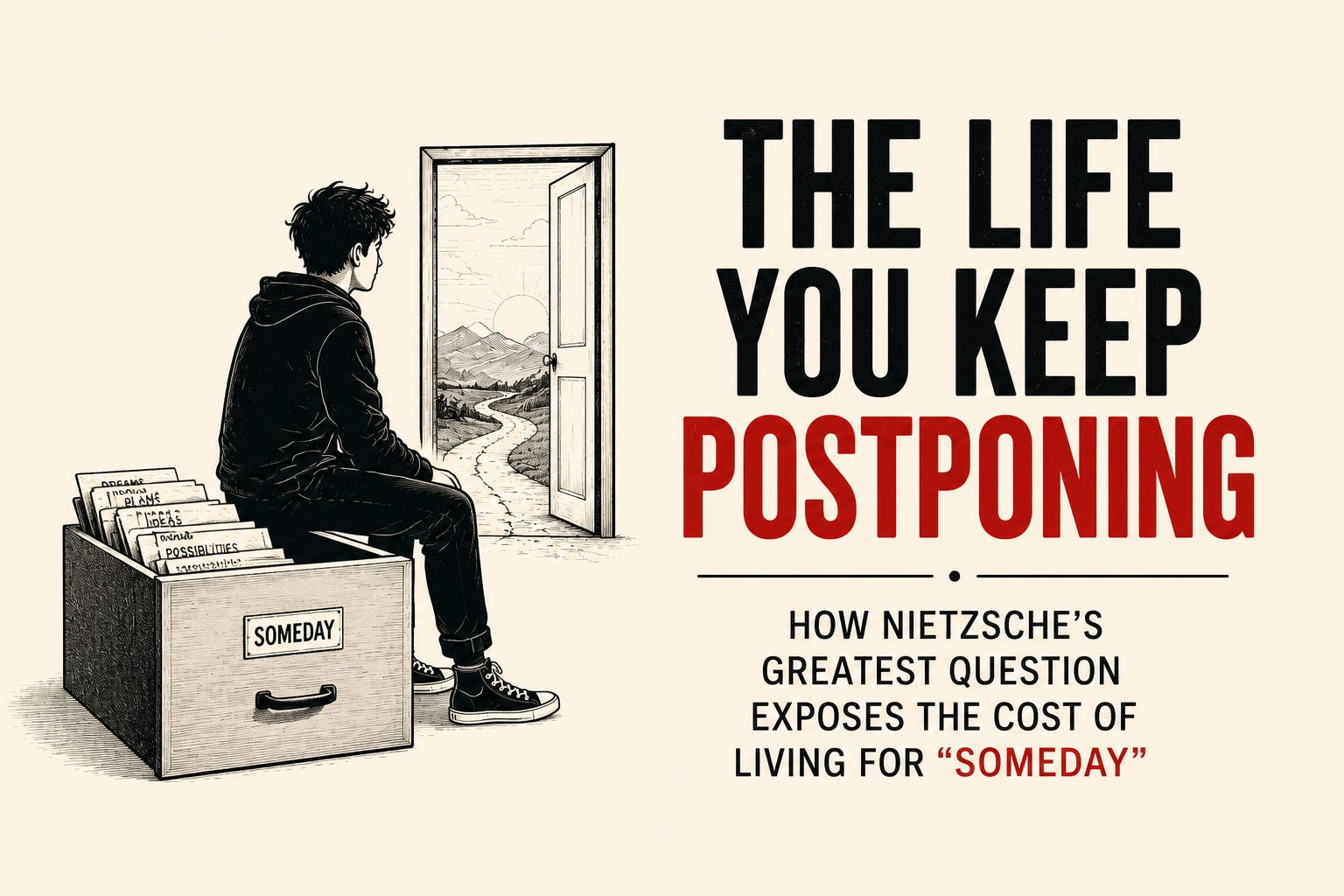
Why the life you dream about may be the very excuse keeping you from living at all
The Most Dangerous Word Is “Later.”
There’s a life you can already picture, not a fantasy, but a specific one. You know what’s in it: the work, the place, the person you’d become. And yet you’re not living it.
Now sit with the part you usually avoid. You’re not failing to reach that life. You’re quietly declining it on a schedule you keep calling “later.”
Stay with me, because I won’t hand you that life. I’ll do something harder. I’ll take away your favorite excuse for not living it: the belief that it’s still coming.
For years, I had a version of myself I kept almost becoming. I researched it. I talked about it. I did everything except live even one hour of it.
The person who finally showed me why was a German philosopher who had been dead for more than a century.
The problem was never that I didn’t want that life. It was something beneath the wanting.
And it has a name.
Before we reach the philosophical question that tests whether a life is even worth living, pause for a moment.
If you’d rather see your life clearly than be reassured about it, you’re in the right place.
Because before we can ask how to change our lives, we have to understand why we keep postponing the lives we already know we want.
If this reflection resonates with you, consider supporting Philosophy Vault. Your one-time support helps keep this work independent.
A cup of coffee for me is a cup of inspiration for you. Support my work through Buy Me a Coffee and help me keep exploring the depths of existence. ☕
The Life You Keep Filing Under “Later”
That life you keep postponing isn’t vague.
It’s specific.
You know the city. You know the work. You know the kind of morning you’d wake up to. You even know the version of yourself who would answer the door.
Some people have carried the same picture for ten years, unchanged, like a photograph tucked inside a wallet they never open.
You haven’t forgotten it.
You mention it casually over dinner.
“One day I’ll actually do that.”
You research it late at night. You probably have a folder, a list, or a collection of saved links dedicated to it.
For years, I called it timing.
I had endless explanations for staying exactly where I was.
“When things settle.”
“Once I’ve saved a little more.”
“This isn’t the right season.”
You have your own version.
You probably used one this week.
Here’s the part almost nobody says out loud.
Waiting feels responsible.
It feels mature.
It even feels as though you’re respecting your dream by refusing to rush it.
But the strange part isn’t that you haven’t reached that life.
It’s what you’ve done instead.
And that difference changes everything.
Managing a Dream Instead of Living It
So what do you do instead?
You manage it. You don’t chase the life. but you don’t abandon it either. You keep it suspended somewhere in between, a place that demands nothing from you.
You plan it. You calculate its cost.
You buy the tools you’ll need someday...
...and leave them untouched in a drawer.
You read stories about people who actually did it. You become remarkably skilled at almost.
Here’s what that gives you.
As long as the dream remains only a possibility...
...it can never fail.
You’ll never have to watch it collapse.
A dream sitting safely inside a drawer has a perfect record.
The moment you try it, even for one honest hour, it becomes vulnerable to disappointment.
So you leave it there.
And you call that being sensible.
I lived this way for years.
I even felt proud of how reasonable I looked.
I convinced myself I was patient.
Careful. Responsible.
In reality, I was protecting the dream by making sure it would never be tested.
Managing something feels like movement.
It isn’t.
You can maintain the idea of a life for ten years without living a single day of it.
Keeping it safe was never the same as truly wanting it. And that realization leads directly to a deeper question.
If time isn’t the real obstacle, then what is?
The answer has nothing to do with your calendar.
Nietzsche’s Question That Changes Everything
That answer appears in the work of Friedrich Nietzsche.
Nietzsche spent much of his adult life in pain.
He endured blinding headaches, constant nausea, failing eyesight, and increasing isolation.
He wrote from rented rooms while being largely ignored during his lifetime.
Then, in 1882, in The Gay Science, he proposed a thought experiment that still unsettles people today.
Imagine your loneliest night.
The house is silent.
A demon sits beside you and whispers:
“This life as you now live it and have lived it, you will have to live once more and innumerable times more.”
Nietzsche called this the greatest weight.
It wasn’t a theory about time. It was a question.
A brutal one.
“Would you want this again?”
Notice what the demon points toward.
Not your dream life.
This one.
This week.
The ordinary life you’ve been carefully managing.
Most people cannot honestly answer yes.
And that is precisely why Nietzsche’s question is so devastating.
It removes every excuse and forces you to confront the life you are actually living—not the one you keep imagining.
The Prison Called “Later”
Many people believe they’re trapped by circumstances.
Often they’re trapped by postponement.
The managed life doesn’t simply perform for other people.
It keeps you too occupied to notice the life you’re refusing to live.
This was never a problem of willpower.
It was never a scheduling issue.
It is a refusal to fully say yes to your own existence.
And force cannot produce that yes.
The way out isn’t more effort.
It’s something quieter.
And much harder.
Fortunately, Nietzsche believed there was another way.
Amor Fati: Loving Your Fate
Six years after introducing the idea of Eternal Recurrence, Nietzsche finally gave the antidote a name.
Amor Fati—love of fate.
He wrote:
“My formula for greatness in a human being is amor fati: that one wants nothing to be different, not forward, not backward, not in all eternity. Not merely bear what is necessary, still less conceal it... but love it.”
Modern self-help often reduces this idea to simple gratitude.
That isn’t what Nietzsche meant.
He wasn’t asking you to become comfortable.
He was asking whether you could love your life enough to live it again forever.
That question changes everything.
Because it shifts your attention away from the life you imagine and back toward the life you are actually living.
The Dream Was Never the Real Problem
Here’s the turning point.
Your refusal to live that imagined life isn’t really about the imagined life.
It’s about this one.
You cannot honestly wish to repeat your life forever if you’re only half-living it now.
That’s why the dream stayed safely inside the drawer.
Keeping it there protected you from discovering something far more frightening.
That if the demon asked about the life you’re actually living...
...your honest answer would be no.
The unlived life isn’t merely a destination you’ve postponed.
It’s a judgment on the life you’re already living.
Facing that truth isn’t about chasing the dream harder.
It’s about answering Nietzsche’s question honestly.
If your answer is no, you haven’t failed.
You’ve simply heard the first truthful sentence about your own life.
From that moment on, the question changes.
It is no longer:
How do I reach that other life?
It becomes:
What would it look like to stop hiding behind it?
Stop Escaping Into “Someday”
The answer is smaller than most people want.
There is no dramatic transformation.
No cinematic morning.
No instant reinvention.
Instead, notice yourself beginning the old sentence:
“Someday I’ll...”
Then stop. Let the sentence remain unfinished. Feel how long you’ve relied on it. When you’re alone, say out loud the life you’ve been postponing.
Then ask the harder question:
Do I truly want this life?
Or...
Do I simply enjoy the comfort of wanting it?
Those are not the same thing.
The difference has probably been hidden beneath years of postponement.
Now allow yourself one strange experiment. For ten seconds...
Simply want what you want.
Without planning. Without organizing.
Without turning desire into another project.
Just feel it.
Notice how quickly your mind reaches for later. That reflex is the entire battle in miniature.
The Only Question That Matters
There is no five-step system here.
Another plan would simply become another elegant form of postponement. Another folder. Another version of later dressed in better language.
Tonight, when everything grows quiet... Put the phone down. Sit with the silence.
Ask Nietzsche’s question about your real week, not your imagined future.
Would you want to live this exact week again, endlessly, forever?
Don’t fix the discomfort.
Don’t immediately build a five-year plan.
Simply stop pretending that the life you’re avoiding is a scheduling problem.
It never was.
You already know which life you would choose if choosing were free.
It isn’t.
It costs the excuse.
It costs the drawer.
It costs the perfect record.
It costs the comfortable ache of almost.
In the end, only one decision has ever been waiting for you:
Keep the fantasy...
...or finally claim a life.
One asks nothing of you tonight.
The other has been yours all along.
Conclusion: The Life That Cannot Wait
Perhaps the greatest tragedy isn’t that we fail to become who we could have been. It’s that we become so comfortable postponing that person that we mistake waiting for living.
Nietzsche’s question was never meant to predict the future. It was meant to expose the present. Every time you postpone what matters most, you quietly answer the demon’s question without saying a word. You declare that this life, exactly as it is, is acceptable to repeat forever, not because you truly love it, but because “later” has become easier than “now.”
Yet the unlived life has a strange power. It never disappears. It waits patiently beneath every excuse, every perfect plan, and every promise that tomorrow will finally be different. It reminds you that the life you imagine isn’t asking for another strategy. It is asking for your courage.
So, before you close this essay, ask yourself Nietzsche’s question one last time, not about the person you hope to become, but about the person you were this week.
If you had to live this exact week again, endlessly and forever, would you embrace it... or endure it?
Whatever your honest answer is, don’t rush to escape it. Sit with it. Because that answer is not your condemnation, it is your invitation. It is the first truthful conversation you have had with your own life.
In the end, the choice was never between success and failure. It was between protecting the fantasy of another life or accepting the responsibility of this one. One keeps your dreams perfectly preserved but forever untouched. The other risks disappointment, uncertainty, and change, but it is the only path that allows a dream to become a life.
Perhaps that is what Amor Fati really demands of us: not that we passively accept whatever happens, but that we stop hiding behind the promise of “someday” and begin living in a way that, if eternity asked us to repeat it, we could finally answer with an unreserved yes.
Tip with a coffee ☕
Thenx For Being Part of Philosophy Vault, If this piece helped you reconnect with yourself, consider buying me a coffee. ☕👇🏻

I enjoyed this, but I think you're sneaking in a pretty big assumption. You seem to assume that once someone sees the truth about their life, they can simply choose differently.
I don't think that's how people work.
Most smokers know smoking is bad. Most procrastinators know they're procrastinating. Most people in unhappy jobs know they're unhappy. Awareness clearly isn't the scarce resource. The hard part isn't seeing. It's changing.
That's why I'm always a little skeptical of essays that end with "just stop postponing," or "just choose the life you really want." If it were that simple, we'd all be different people by next Tuesday.
Human beings are bundles of habits, fears, biology, family history, obligations, and contradictions. Sometimes we know exactly what we should do for years before we become capable of doing it.
So when you write that *"the choice has been yours all along,"* I find myself asking: has it?
For some people, yes. For many others, the choice is real, but their capacity to act on it isn't equally available. That's not making excuses; it's recognizing that agency comes in degrees, not as an on/off switch.
I still think Nietzsche's question is a great one. I just think answering it honestly is the easy part. Living the answer is where philosophy usually hands the microphone over to psychology.
I actually like this ending because it's a little provocative without being combative:
"Philosophy is very good at telling us what a free person ought to do. Psychology spends much more time asking whether the person is free enough to do it."
That, to me, is the question this essay quietly sidesteps. It treats human agency as if it's simply waiting to be exercised, when for many people, agency itself is part of the problem.
The question is only complete, when one is dying.