
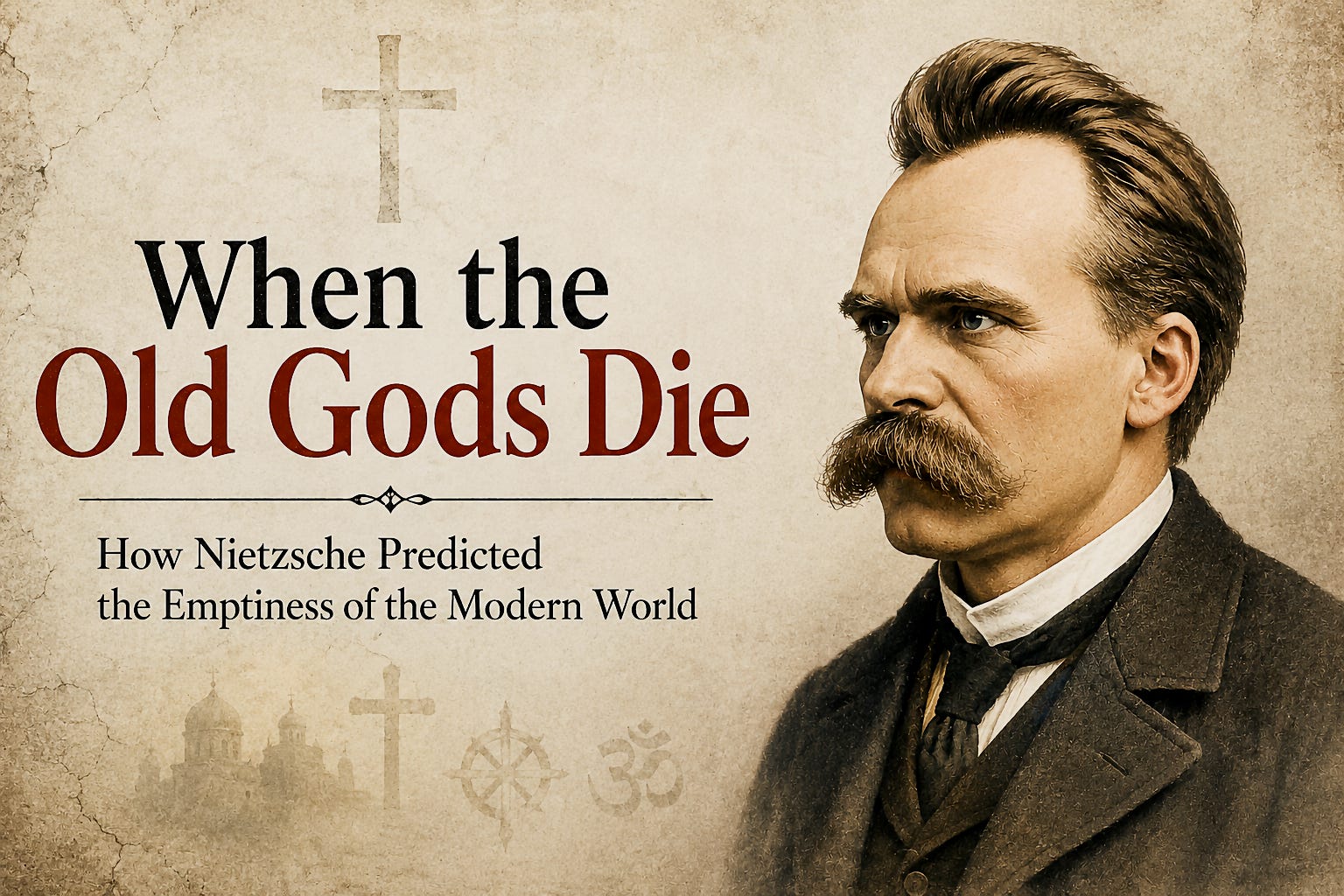
When the Old Gods Die
How Nietzsche Predicted the Emptiness of the Modern World

The greatest crisis of our age is not political or economic-it is spiritual.When old beliefs collapse and nothing replaces them, nihilism quietly takes root.
Why Is Nihilism Taking Over Modern Society? Nietzsche Predicted It
Imagine waking up one morning and everything you believed in, your values, your goals, your sense of purpose, suddenly feels hollow. Imagine questioning whether anything you do truly matters, whether meaning itself is nothing more than an illusion. This, in essence, is the shadow that hangs over our modern world.
It is a phenomenon we call nihilism. And few thinkers understood and foresaw its rise as profoundly as Friedrich Nietzsche.
Why is nihilism spreading so powerfully in modern society? What did Nietzsche mean when he declared God is dead? And what future did he see for humanity once our traditional foundations of meaning collapsed?
If this reflection resonates with you, consider supporting Philosophy Vault. Your one-time support helps keep this work independent
A cup of coffee for me is a spark of inspiration for you. If my writing helps you see the world differently, consider supporting my work through Buy Me a Coffee. ☕
The Collapse of the Old Gods
Nihilism, at its core, is the belief that life lacks inherent meaning, value, or purpose. It is not simply a philosophy of despair, it is a confrontation with emptiness.
For centuries, human beings relied on religion, tradition, and collective myths to guide their lives. These structures provided stability. They told us who we were, what was right and wrong, and where we were going. But Nietzsche observed, with both brilliance and anguish, that these pillars were crumbling in the modern age. The Enlightenment eroded the authority of religion. The Industrial Revolution replaced old traditions with rapid urbanization and technology. And in this vast shift, Nietzsche declared that the cultural foundation of the West, its reliance on the Christian God as the ultimate source of meaning, had collapsed.
When he wrote:
“God is dead,”
he was not speaking of a literal death, but of the decline of faith as a guiding force in society. The tragic irony, Nietzsche warned, is that humanity was unprepared to face the abyss that would follow.
Do you not sense this very abyss today? Institutions once trusted now face skepticism. Religious influence wanes across much of the world. Communities fragment under the weight of individualism. Consumerism tells us to replace meaning with material possessions. Social media bombards us with endless noise, yet leaves us feeling emptier than ever before.
This is the landscape Nietzsche foresaw: a world where old values no longer hold, but new ones have yet to be created.
The Silent Epidemic
Nihilism today does not always wear a dark cloak of despair. Often it hides behind entertainment, technology, and the endless pursuit of novelty. When everything becomes a distraction, and distraction becomes a way of life, we risk losing connection to deeper purpose. This is the silent epidemic of modernity, the ability to keep ourselves busy while starving our inner world.
Psychologist Viktor Frankl, a Holocaust survivor and author of Man’s Search for Meaning, frequently drew upon one of Nietzsche’s most famous insights:
“He who has a why to live can bear almost any how.” — Friedrich Nietzsche
Frankl believed this idea captured a profound psychological truth: when people have a sense of meaning, they can endure even the greatest suffering.
But what happens in a society that no longer provides a collective why? When life is reduced to mere survival, comfort, or consumption, we begin to experience what Frankl called the existential vacuum, a sense of inner emptiness that cannot be filled by wealth or pleasure.
Look closely at certain cultural trends: the obsession with status, the craving for constant validation online, the glorification of hustle culture followed by waves of burnout and disillusionment. These are not random. They are signs of a society trying to compensate for the loss of higher meaning by overindulging in surface-level pursuits. Nietzsche warned that when the old gods die, new idols, of fame, power, and endless consumption, rush to take their place.
Another striking sign of modern nihilism is the crisis of identity. In a world where traditional anchors such as religion, family roles, and community ties weaken, many feel adrift. We now live in a time where people can reinvent themselves with a few clicks, yet the freedom to define ourselves comes with the burden of constant uncertainty. Unlimited choice, paired with a lack of solid ground, only intensifies the feeling of meaninglessness.
When people lack meaning, they become more susceptible to extremism, ideological, political, or self-destructive. We see this in the polarization of today’s world, where individuals cling to tribal identities or outrage as substitutes for deeper values.
The Overman and the Creation of Meaning
Nietzsche was not content with despair. He believed that the collapse of old values, as terrifying as it seemed, was also an opportunity. He wrote of the Übermensch, the Overman, as a figure who could create new values, who could take the raw chaos of existence and mold it into something life-affirming.
This concept has been widely misunderstood and misused. It was never about domination over others or physical superiority. Rather, it described a new kind of human being, one who refuses to be crushed by the weight of nihilism, and instead chooses to create their own meaning and values. The Overman is the person who stops waiting for society, religion, or fate to dictate what their life should stand for. They recognize the frightening but liberating truth: meaning is something we create, not something we passively receive.
This is both empowering and unsettling. Empowering because it tells us we are not doomed to despair. Unsettling because it leaves us without excuses. If there is no higher authority to tell us how to live, the responsibility for our choices, our failures and our triumphs, falls entirely on us.
Psychologist Carl Jung added an important dimension here. He warned that if we do not consciously integrate meaning into our lives, the unconscious will fill the void with destructive forces, what he called the shadow, a reservoir of unacknowledged fears, desires, and resentments that can erupt harmfully, both individually and collectively.
Amor Fati: Saying Yes to Existence
How can we begin to embody the spirit of the Overman today, in an age of noise, disconnection, and constant distraction? Nietzsche’s writings suggest several key attitudes: the courage to question inherited norms and discard values that no longer serve life; the willingness to endure uncertainty without retreating into illusions; and the active choice to shape one’s life with intention — to build values that affirm existence rather than reject it.
Central to this is the practice of amor fati, the love of one’s fate. This is the attitude of saying yes even to the hardships and tragedies of life, embracing them as necessary parts of one’s journey. This perspective transforms suffering into an opportunity for growth and resilience.
Have you ever faced a challenge that, in the moment, felt unbearable, but later became the very experience that shaped you into a stronger, wiser version of yourself? If so, you have already touched the essence of amor fati.
Nietzsche believed that if enough individuals began creating their own values and affirming life, society as a whole could evolve beyond the despair of nihilism. Cultural renewal begins not with governments or institutions, but with each person daring to live authentically and courageously.
The Eternal Recurrence
Nietzsche’s most radical and transformative idea is the concept of eternal recurrence. He asks us to imagine a thought experiment: what if you had to live your life exactly as it is, over and over again, for all eternity? Every joy, every mistake, every triumph, every heartbreak, repeated endlessly, with no possibility of change.
At first, this thought seems horrifying. But Nietzsche did not present it as punishment. It was a test.
If you could affirm your life so fully, with such profound acceptance, that you would gladly live it again and again, then you would have truly overcome nihilism. To say yes to eternal recurrence is to embrace existence in its totality, not merely the pleasurable parts, but the whole, as your own creation.
This, Nietzsche believed, was the ultimate answer to the void. Not denial, not escape, but radical affirmation. To live in such a way that you would welcome the eternal return of your life is to embody the deepest possible love of existence.
Think for a moment: if your life had to be repeated forever, would you live it differently? Would you waste less time, love more deeply, pursue your passions more courageously? This question is not abstract. It is an invitation to transform the way you live right now.
Psychologists today recognize a similar principle in mindfulness and acceptance, the idea of embracing the present moment fully, without resistance, echoes Nietzsche’s radical yes to life. Frankl, too, affirmed that even in the most unbearable suffering, we can choose our attitude, and through that choice, reclaim meaning.
Meaning Is Made, Not Found
The rise of nihilism in modern society is not a sign that humanity is doomed. It is a sign that we are being pushed to evolve, to move beyond inherited meanings and step into the terrifying freedom of creating our own.
When you dare to embrace your life fully, when you stop waiting for meaning to be handed to you and instead begin to shape it with your choices, you step into the power Nietzsche believed humanity was capable of. You become not a passive victim of history, but a creator of destiny.
Nietzsche’s message was not one of hopelessness, but of fierce empowerment. He dared us to confront the void, not to shrink from it, and in doing so, to discover that meaning is not found. It is made.
Perhaps the spread of nihilism is not the end of meaning, but the beginning of a new era of human creativity, courage, and depth, an era where each of us becomes a philosopher, an artist, and a creator of our own existence.
Life has the meaning we dare to give it. And when we say yes to existence — fully, without hexistence, we do not just survive nihilism. We transcend it.
Tip with a coffee ☕
Thenx For Being Part of Philosophy Vault, If this piece helped you reconnect with yourself, consider buying me a coffee. ☕👇🏻

Nietzsche's framing of nihilism as an opportunity – the collapse as the precondition for the new – maps almost exactly onto what I see in career transitions after AI displacement. People arrive having lost the structure that organized their sense of purpose. They often expect me to restore it. The harder, truer work is what you're describing: learning to build a value system rather than waiting to receive one.
The Overman concept is easier to grasp, I've found, when someone has actually been in the abyss. Abstraction becomes concrete fast when the old gods are visibly gone.
The idea that the Old god is dead in itself beautifully captures Nietzsche's take on nihilism and Overman. Here Spinoza's God becomes important. If for Nietzsche god is dead meant that society has lost its anchor for morality, Spinoza would say that God is the single infinite ocean of the real being the reality like Brahman and we are ripples in that ocean like Atman. When that cosmic consciousness is reflected in our mental constructs it's then we realize God via our actions. But Spinoza being Spinoza would argue that because this cosmic consciousness is absolute truth it ought to have a manifestation and that would be possible only when we use the psychological drive (Conatus) and physical drive to be the Free man in Spinoza's ideal state.
Now if Spinoza's Intellectual Love of God is not realized that is the moment the individual wave (Atman) realizes it is part of the infinite ocean (Brahman) is not realized it's then that Nietzsche 's God dies and humans degenerate into nasty and brutish beings of satate of nature. Hegel too could help here when he says his God is geist that is waking up in the realm of the state.