

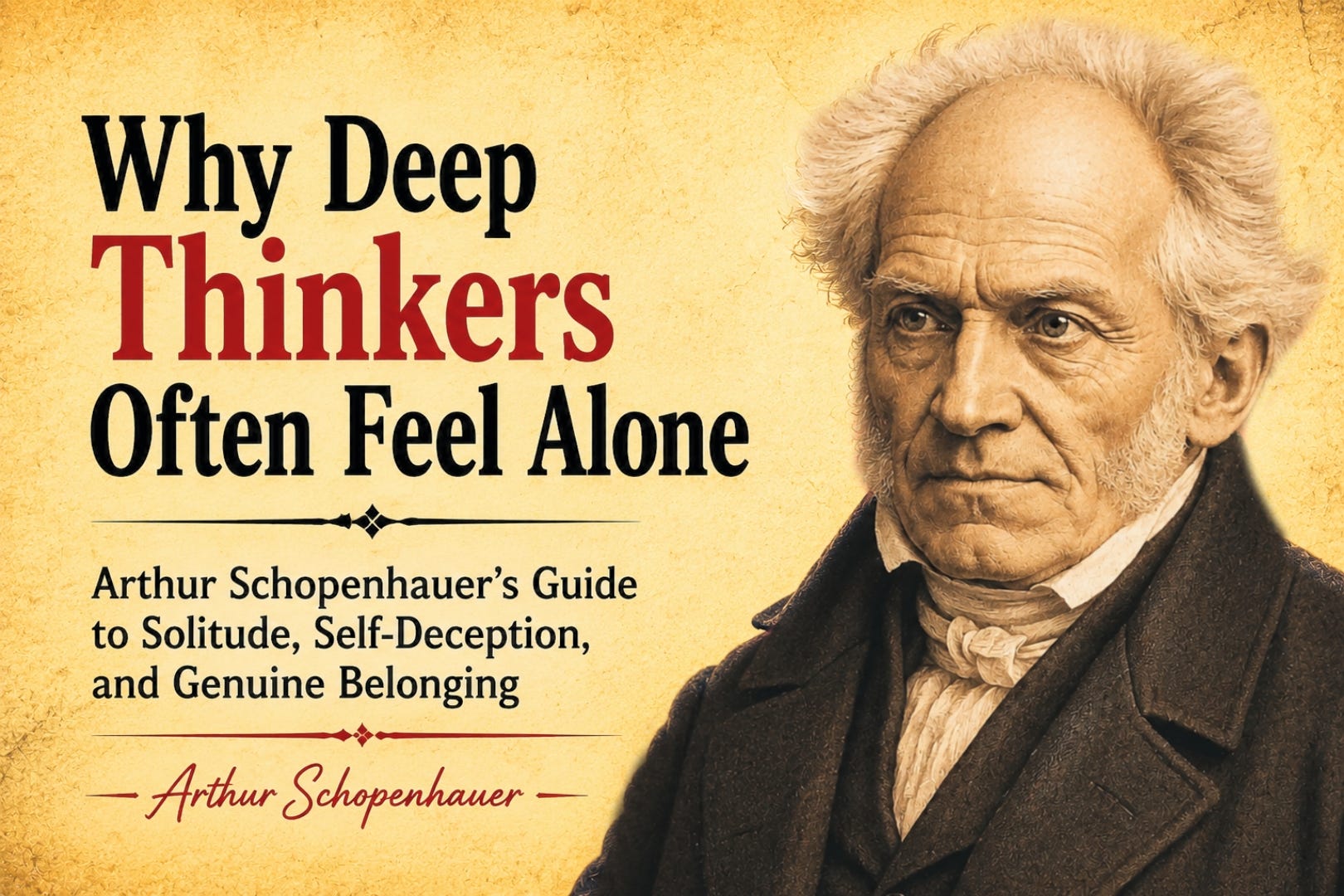
Why Deep Thinkers Often Feel Alone
Arthur Schopenhauer's Guide to Solitude, Self-Deception, and Genuine Belonging

The Hidden Cost of Seeing Too Clearly: Why Insight Can Make You Feel Alone
The people who see too much
There is a particular kind of loneliness that has nothing to do with being physically alone. It appears in crowded rooms, at dinner tables, and at parties where everyone seems to be enjoying themselves. You stand among people, listening to conversations, watching laughter rise and fall, yet something feels strangely distant. You notice the rehearsed smiles, the carefully chosen words, and the invisible performances unfolding beneath ordinary interaction. Eventually, you make a quiet excuse, mention an early morning, and leave long before everyone else.
It’s tempting to believe this means something is wrong with you. Perhaps you’re antisocial, emotionally detached, or simply incapable of fitting in.
But what if your isolation is not a defect?
What if it is the price of seeing certain things that are usually invisible?
The German philosopher Arthur Schopenhauer understood this tension long before modern psychology attempted to explain it. Yet his insight carries a warning as well. Clear perception can reveal uncomfortable truths about the world, but if left unchecked, it can also become a prison built from your own sense of superiority.
There are three invisible walls that often separate thoughtful people from genuine belonging. The first two are easy to blame on the world around you. The third is much harder to face because it asks you to question yourself.
If this reflection resonates with you, consider supporting Philosophy Vault. Your one-time support helps keep this work independent
A cup of coffee for me is a spark of inspiration for you. If my writing helps you see the world differently, consider supporting my work through Buy Me a Coffee. ☕
Wall One: When You Can No Longer Believe the Performance
Most human relationships begin with rituals rather than revelations.
Small talk about the weather, work, sports, traffic, or weekend plans rarely exists to exchange meaningful information. These conversations serve another purpose. They reassure us that we are safe with one another. Their value lies less in the words themselves than in the feeling they quietly communicate.
“I’m safe. You’re safe. We’re on the same team.”
For most people, these rituals create warmth long before they create intimacy.
The problem begins when you start seeing through them.
Once you become highly attentive to social dynamics, casual conversation no longer feels effortless. Instead of hearing connection, you hear performance. Instead of seeing spontaneous interaction, you notice predictable scripts repeating themselves.
You begin observing how often people laugh to ease tension rather than because something is genuinely funny. Compliments become negotiations. Opinions become signals of belonging. Conversations begin to resemble carefully managed performances more than authentic exchanges.
The tragedy is that insight doesn’t allow you to return to innocence.
Once you’ve recognized the machinery behind social interaction, it becomes almost impossible to forget it.
Many people mistake this shift for emotional maturity, but it often feels less like wisdom and more like exhaustion. You may find yourself speaking while simultaneously observing yourself speak, aware that your own words are filling silence rather than expressing anything meaningful.
This awareness creates distance.
Not because you dislike people, but because participating in conversations that once felt natural now feels strangely artificial.
It is important, however, not to mistake observation for superiority.
The fact that social rituals contain performance does not make them dishonest. Every society depends on small gestures that create trust before vulnerability becomes possible. What appears superficial may simply be the language through which strangers slowly become friends.
The first wall, then, is not that people are fake.
It is that your awareness has become so sharp that ordinary human rituals no longer satisfy you in the way they once did.
Wall Two: The Burden of a Rich Inner World
When surface-level interaction loses its appeal, something else quietly changes.
Your standards for connection begin to rise.
You no longer seek conversation merely to pass time. You long for dialogue that uncovers something real, ideas that challenge you, confessions that reveal genuine vulnerability, or questions that linger long after the conversation ends.
This is where Schopenhauer’s observations become deeply relevant.
Few philosophers understood solitude as intimately as he did. Brilliant, uncompromising, and notoriously difficult, he spent much of his life isolated from the intellectual recognition he believed he deserved. His writings reflect both remarkable psychological insight and the emotional cost of carrying it.
He once observed:
“A person of real inner wealth wants little from other people and mostly wants to be left alone.”
There is profound truth in those words.
A rich inner life often reduces dependence on constant social stimulation. People who spend long hours thinking, reading, reflecting, or creating naturally develop a world within themselves that few external conversations can easily match.
But there is also danger hidden inside this insight.
If your inner world becomes your only refuge, ordinary human connection begins to feel insufficient. Conversations that once seemed pleasant now appear empty. Rooms full of people can leave you feeling emotionally starved rather than socially fulfilled.
It is not always because no one around you possesses depth.
Sometimes it is because genuine depth is rare.
Modern life rewards speed over reflection, certainty over curiosity, and distraction over introspection. Many people spend years avoiding difficult questions about themselves because busyness offers a convenient escape from self-confrontation.
As a result, when you seek conversations rooted in honesty rather than performance, you often discover that very few people are willing, or prepared, to meet you there.
This creates a painful mismatch.
You are searching for discussions that descend beneath appearances, while many people understandably remain where conversation feels comfortable and emotionally safe.
Loneliness begins to emerge not from physical isolation but from a difference in depth.
Yet this second wall carries a subtle temptation.
It quietly invites you to believe that everyone else is shallow while you alone are searching for something real.
That belief feels strangely comforting because it explains your loneliness without asking anything difficult of you.
If no one understands you, then perhaps the world is simply too superficial.
Perhaps you are destined to remain apart.
It is an appealing story.
Unfortunately, it is also incomplete.
Because there is one final wall—far less flattering than the first two—that often holds the others in place.
And unlike the first two, this wall does not exist outside you. It exists within you.
Wall Three: When Clarity Becomes Armor
The first two walls are relatively easy to accept. They suggest that your loneliness is simply the consequence of seeing the world more clearly than most people do.
The third wall is far more uncomfortable because it asks a different question.
What if part of your isolation is something you have chosen without realizing it?
Somewhere along the way, clear perception can quietly harden into contempt.
You stop merely noticing social performances and begin judging them. Ordinary conversation feels beneath you. Familiar gatherings become predictable. You leave early, telling yourself you have outgrown the room.
At first, this feels like discernment.
In reality, it often functions as protection.
There is a subtle comfort in believing that you are “too deep” for shallow company. That story transforms loneliness into distinction. Instead of feeling rejected, you feel exceptional. Instead of admitting vulnerability, you convince yourself you simply belong somewhere higher.
But beneath that belief often lies a quieter fear.
“Too deep to belong” is frequently easier to believe than “I’m afraid of being seen without the identity I’ve built around my depth.”
Depth can become an identity just as easily as popularity or success.
If every conversation becomes a test of whether someone is profound enough, you never have to risk being ordinary yourself. You remain an observer rather than a participant, protected from rejection by the distance you maintain.
This is the hidden function of superiority.
It is not confidence.
It is armor.
Schopenhauer himself serves as both an extraordinary guide and a cautionary example. His understanding of solitude remains remarkably insightful, yet his own life reminds us that perception alone does not guarantee wisdom. One can see the world’s illusions with perfect clarity while still becoming imprisoned by bitterness.
Insight without humility slowly isolates itself.
The Porcupine’s Dilemma
Perhaps Schopenhauer’s most enduring metaphor captures this struggle better than anything else.
He imagined a group of porcupines huddling together on a freezing winter night.
As they move closer for warmth, their quills wound one another, forcing them apart. Yet the cold drives them together again. Eventually, they settle at a distance that offers enough warmth to survive while minimizing the pain.
Human relationships often work the same way.
Closeness inevitably exposes us to disappointment, misunderstanding, and conflict. Distance protects us from those wounds, but it also leaves us cold.
The challenge is learning the difference between necessary distance and unnecessary isolation.
Some people genuinely require more solitude than others. Some conversations truly lack depth. Some relationships simply cannot nourish the person you are becoming.
That distance is real.
But another kind of distance is manufactured.
It is created by fear disguised as discernment.
From the inside, these two experiences feel almost identical. Both lead you to leave the party early. Both tell you that you don’t belong.
Only one of them is telling the truth.
What Psychology Suggests—and What It Doesn’t
Modern research offers interesting clues about the relationship between intelligence, introspection, and social life, but it deserves careful interpretation.
Some studies suggest that highly intelligent individuals may derive less satisfaction from frequent social interaction than average. Other research has reported elevated rates of anxiety and mood disorders among certain high-IQ populations.
Yet these findings remain far from conclusive. Several studies rely on highly selective groups, while larger population samples have failed to reproduce some of the stronger claims.
The evidence points toward a possibility, not a universal law.
It should never become an excuse.
Your loneliness is not proof of superior intelligence, nor is intelligence a guarantee of loneliness.
Human beings remain far more complicated than any single study can explain.
The Courage to Be Ordinary
Popular advice often tells lonely people to “find your tribe.”
There is some truth in that idea, but it can also become another comforting illusion. If you spend your life waiting for perfectly compatible people to appear, you may unknowingly reinforce the very walls keeping everyone else out.
Belonging begins somewhere much smaller.
It begins when you separate two different kinds of loneliness.
The first is unavoidable.
It is the quiet solitude that accompanies a reflective mind. Some distance will always remain because thoughtful people naturally spend more time questioning, observing, and reflecting than most.
Accept that distance.
Do not mistake it for failure.
The second loneliness is optional.
It is the loneliness created by superiority, perfectionism, and emotional self-protection. It whispers that no one deserves to know you until they prove themselves worthy.
That loneliness is not insight.
It is fear wearing philosophical language.
The way forward is surprisingly simple, though rarely easy.
Speak the honest sentence instead of the impressive one.
Resist the urge to demonstrate how perceptive you are.
Become genuinely curious about another person’s experience instead of measuring whether it matches your own depth.
Allow ordinary moments to remain ordinary without silently judging them.
These small acts feel strangely vulnerable because they remove the armor.
For perhaps the first time, people meet you rather than the identity you built around your intelligence or perception.
The Quiet Freedom Beyond the Walls
None of this means you will suddenly enjoy every social gathering.
You may still leave early.
You may still prefer books to crowds, silence to noise, and a meaningful conversation with one person over an evening spent entertaining many.
Some of that distance is simply part of who you are.
What changes is the reason you carry it.
Loneliness no longer becomes evidence of your uniqueness.
It becomes one ordinary part of being human.
And when the need to appear profound finally loosens its grip, something unexpected happens.
You begin discovering that genuine connection rarely arrives through dazzling insight. It arrives through ordinary honesty.
You stop asking whether people are deep enough for you.
Instead, you ask whether you are willing to let a few people know you without the performance.
That shift changes everything.
Because depth without humility becomes another performance.
True wisdom does not separate itself from humanity.
It returns to it.
Perhaps you were never meant to belong everywhere.
Very few people do.
But you may discover that real belonging has never depended on finding people capable of matching every layer of your mind.
It depends on having the courage to let someone meet you before you have the chance to impress them.
In the end, the question is no longer whether the world understands you.
The more important question is whether you are willing to stop hiding behind the identity that loneliness built for you.
That is where the walls begin to fall.
And that is where genuine belonging quietly begins.
Tip with a coffee ☕
Thenx For Being Part of Philosophy Vault, If this piece helped you reconnect with yourself, consider buying me a coffee. ☕👇🏻

I loved this essay. I consider myself a systems thinker, someone who naturally looks for patterns, especially those that appear unrelated at first glance. One pattern I noticed early in life was how some of my most brilliant aunts and uncles gradually became more reclusive as they aged.
When they were younger, they eagerly shared ideas, debated different perspectives, and enjoyed intellectual exchange. But over time, they seemed to withdraw from those conversations. Eventually, several of them told me they had come to trust that I was capable of figuring out the world for myself, and no longer felt the need to persuade or guide me.
As I have grown older, I have begun to recognize the same tendency within myself. I find that I am more selective about the conversations I engage in, not because my curiosity has diminished, but because I have become more aware of the limitations that naturally accompany aging. I notice subtle changes in certain cognitive processes, particularly memory. Sometimes I hesitate to express a complex idea because I worry that I may not recall every nuance of a previous argument, leaving my thoughts vulnerable to being misunderstood or interpreted as contradictory.
I suspect these two forces work together. With age often comes both a greater appreciation for the limits of persuasion and a greater awareness of our own cognitive imperfections. The result is not necessarily a loss of curiosity, but a growing preference for thoughtful observation over constant debate. Perhaps wisdom is not simply knowing more, but also recognizing when silence communicates more effectively than another argument.
I wonder how may people who "see to much" are highly sensitive persons (HSP). I feel like there is a lot of overlap in the experience.