
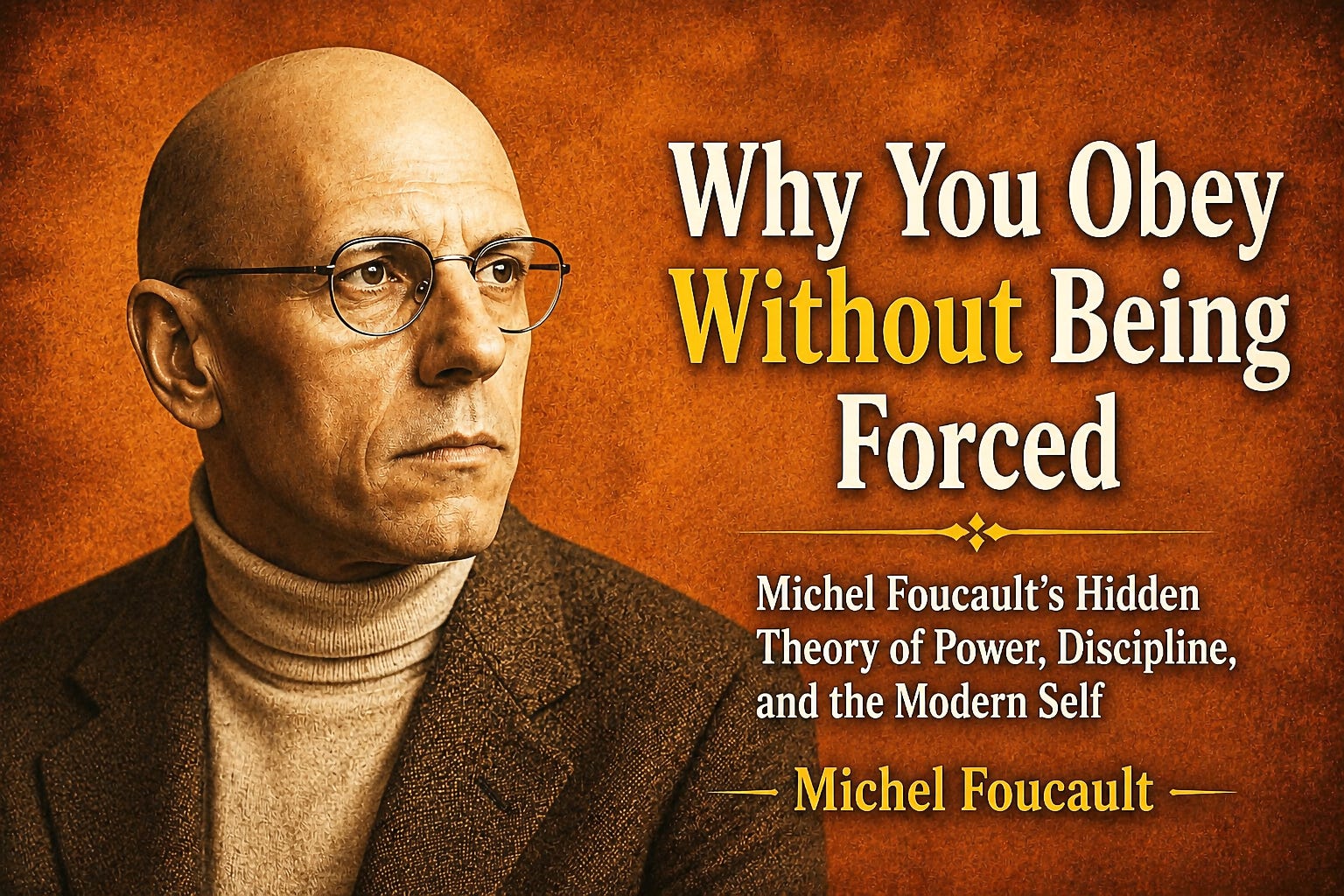
Why You Obey Without Being Forced
Michel Foucault's Hidden Theory of Power, Discipline, and the Modern Self

The most powerful prison isn’t built with walls or bars. It’s built inside your mind, where you become both the prisoner and the guard.
The Warden You Never Hired
You think you’re free because no one is standing over you. No boss in the room. No priest in the box. No guard at the door. You wake up and discipline yourself anyway. You count your steps. You track your sleep. You monitor your face in the mirror before you leave the house, checking that it says the right thing. You do this without being told to. And that, according to Michel Foucault, is exactly how power stopped needing anyone to tell you anything at all.
For most of history, power looked like a man with a sword. It sat on a throne, wore a crown, cut off heads in the town square so everyone could watch. Power was visible, dramatic, and located in a body, the king’s body. If you wanted to know who had power, you looked for the man with the biggest chair.
Foucault spent his life arguing that this story, while true once, stopped being the interesting one. Modern power doesn’t announce itself. It doesn’t need to. It got smarter. It stopped trying to crush people from outside and started teaching people to crush themselves from inside, and it did this so well that most of us mistake the result for our own personality.
If this reflection resonates with you, consider supporting Philosophy Vault. Your one-time support helps keep this work independent
A cup of coffee for me is a spark of inspiration for you. If my writing helps you see the world differently, consider supporting my work through Buy Me a Coffee. ☕
The Prison That Taught Everyone Else
Foucault’s favorite example was the prison, and specifically a design called the Panopticon: a circular building with a guard tower in the center and cells around the rim, built so that any prisoner might be watched at any moment, without ever being able to tell if the watcher is actually there.
Here’s the trick. After a while, it doesn’t matter if the tower is empty. The prisoner behaves as though it’s occupied because the possibility of being watched is enough to produce obedience. The prisoner becomes his own guard. The surveillance moves inside him, and now he’ll do the institution’s work for free, forever, with no one having to lift a hand.
Foucault put the mechanism itself in five words:
“Visibility is a trap.”
Foucault’s point was that this design didn’t stay in the prison. It became the blueprint for the school, the hospital, the factory floor, the office with the glass walls, the open-plan desk pod. Anywhere you’ve felt the specific tension of acting as though someone might be watching—even alone, even now—you’ve met the Panopticon. It doesn’t need cameras anymore. It just needs you to have internalized the idea that you might, at any second, be seen and judged. You’ve done the rest yourself.
Discipline Doesn’t Punish. It Produces.
This is the part people skip past too fast. Foucault wasn’t just describing punishment, he was describing production. Discipline, in his sense, isn’t primarily about stopping bad behavior. It’s a technology for manufacturing a certain kind of person: punctual, measurable, efficient, and self-correcting.
The factory needed workers who showed up on time without being dragged there. The school needed students who sat still without a whip. The modern workplace needed employees who optimize themselves on their own time, using their own money, buying their own trackers and journals and productivity systems, and calling it self-improvement.
That’s the twist Foucault would want you to sit with. The disciplined self doesn’t feel like obedience. It feels like virtue. You’re not being punished into it. You’re proud of it. You post about your 5 a.m. routine. You feel superior to the person who sleeps in. The power has succeeded completely at the exact moment you experience its demands as your own free choices, chosen for your own good, monitored by nobody but yourself, which is, of course, the most efficient guard there is.
Where the Truth Comes From
Foucault added one more twist that makes the trap harder to see. He argued that power doesn’t just control what you do. It controls what counts as true.
Every era has its experts who get to say what’s normal, what’s healthy, what’s deviant, what’s productive, what’s a disorder—and those categories don’t float down from neutral science. They come from institutions with their own stakes in the answer. The doctor, the psychiatrist, the productivity guru, the algorithm recommending your next article, all of them are, in Foucault’s phrase, producing knowledge that just happens to keep the existing arrangement running smoothly.
And even here, Foucault refused to let the picture turn into pure hopelessness. He insisted that power is never one-directional:
“Where there is power, there is resistance.”
This is why he thought the most dangerous power was never the kind that says obey. It’s the kind that says this is simply what a healthy, successful, disciplined person looks like, because you can rebel against an order. It’s much harder to rebel against a definition you’ve already accepted as fact.
The Trap Inside the Cure
Here’s where this gets uncomfortable for anyone chasing self-mastery, and it’s worth sitting with rather than skipping. The entire self-optimization industry, the trackers, the discipline challenges, the people counting how many times a day they smile so they can train themselves out of it, is not an escape from disciplinary power. It’s disciplinary power working exactly as designed.
You’ve simply become the warden and the prisoner in the same body, watching yourself more precisely than any institution ever could, and calling the result freedom.
Foucault never offered a clean way out of this, and he’d be suspicious of anyone who claims to sell you one, including, especially, anyone selling a program to make you “unreadable” or “terrifying,” because that program is just a new set of behaviors to monitor in the mirror, a new tower to build in your own head.
What he did offer was smaller and harder: notice the tower. Notice when you’re performing for a watcher who may not even be there. Ask who benefits from the definition of normal you’re currently disciplining yourself against. That won’t make you a ruler of anything. It also won’t turn your own mind into a prison you decorated yourself and mistook for a palace.
The Only Real Question
So before you optimize one more habit, ask what Michel Foucault would ask: Who taught you to want this, and what do they gain from your obedience?
Sometimes the answer is genuinely you. The discipline is yours, chosen for your own reasons, and there’s nothing wrong with that. But you cannot know the difference until you examine the tower. Most people never do. They spend their lives watching themselves, correcting themselves, and measuring themselves, never realizing that the eyes they obey were placed there long ago.
Conclusion: The Prison Without Walls
The greatest triumph of modern power is not that it controls your actions. It is that it convinces you its voice is your own.
The moment you stop questioning where your desires, fears, ambitions, and standards came from, you become both the prisoner and the warden, enforcing rules that no one needs to impose anymore. The prison no longer needs walls because it has moved inside your mind.
True freedom, then, is not the absence of discipline. It is the ability to choose your discipline consciously rather than inherit it unconsciously. It is the courage to question the invisible rules that shape your identity before calling them your own.
As Michel Foucault reminds us, real resistance does not begin by overthrowing governments or rejecting authority. It begins with examining the authority that has quietly taken residence inside your own mind.
So before you chase the next habit, the next goal, or the next version of yourself, pause and ask a simple but unsettling question:
“Am I becoming who I truly want to be, or merely becoming what I have been taught to admire?”
Because the most dangerous prison is not the one that locks your body. It is the one that teaches you to guard your own soul, mistakes obedience for freedom, and leaves you believing that the prison was your own idea all along.
And perhaps that is Foucault’s greatest lesson: the first act of freedom is not escaping the prison, it is recognizing that you have been living inside one.
Tip with a coffee ☕
Thenx For Being Part of Philosophy Vault, If this piece helped you reconnect with yourself, consider buying me a coffee. ☕👇🏻

Foucault was writing before social media. His examples were schools, prisons, hospitals and factories. Today social media amplifies almost every mechanism he described. Visibility becomes constant, surveillance becomes participatory, judgment is immediate and self monitoring becomes continuous. The Panopticon has become decentralized. AI may be turning it into something even more powerful. More Matrix then the prison Foucault imagined.
Interesting, but a little overblown. I don't believe most people discipline themselves to meet someone else's ideals. On the contrary, I question whether people nowadays have much self-discipline at all. But I suppose that is a different topic.